Wednesday, 5 August 2015

The Commercial Solar Rooftop Market - Fitting A Quart into a Pint Pot

he solarblogger examines the opportunities and challenges for PV on commercial rooftops.

Commercial Rooftop Solar was only 8% of the Market in 2014


It seems to be accepted wisdom that the commercial rooftop sector is set to be the next big thing in solar. In recent weeks companies more commonly associated with the solar farm sector such asLightsource, Conergy and Lark have announced their intention to develop commercial rooftop divisions.

Indeed, there are good reasons to expect the commercial rooftop segment to take off.  As feed in tariff support has been gradually withdrawn, the savings on electricity bills become a greater and greater proportion of the financial justification for solar PV.  Unlike the domestic sector the daytime energy use in office buildings and factories is well matched to solar energy production.  

Unlike ground mounted solar farms, the aesthetics of solar on factory, warehouse and barn roofs isn’t the least bit controversial.  Even the most virulent strain of Daily Mail journalist couldn’t really complain about the ‘industrialisation’ of an industrial estate, could they?  Actually, don’t answer that question, but you get the point.

Commercial rooftops offer installations at a scale to drive low installation costs. Industrial estates often already have chunky electricity supplies.

This combination of scale, self-consumption, and relaxed attitude to aesthetics has created a real sweet spot for solar.  Commercial rooftop seems to be the sector that’s closest to a subsidy-free market. 

Despite this, mid-size commercial rooftops (which I've taken as >50kWp FIT non-standalone) represented only 8% of the PV capacity installed in 2014, far behind solar farms (assumed to be RO funded) with 64% and domestic scale FIT with 19% of the market. Given all this, it’s hardly surprising that many people have identified this sector as providing a real opportunity for growth.


The Challenges


For sure, the sector faces challenges.  Demanding hurdle rates or payback times are common for investment decisions in commercial businesses.  Making an offer that works for both a landlord and their tenants and the limitations of our creaky electricity grid could all be potential barriers to deployment.  

However, these challenges are as nothing compared to the emerging risk to the Feed in Tariff (FIT). 

The level of quarterly deployment that triggers a 3.5% degression to the FIT has been set at 50MWp for systems above 50kWp.  This band was recently split into standalone systems and systems supplying buildings.  The trigger level for systems supplying buildings has reduced to 32.5 MWp going forward, an annual deployment level of 130MWp.

The graph shows deployment for the combined segment, which has risen from 2012 to breach the degression trigger twice in the last four quarters.

The FIT depression cap has already been breached in 2 of the last 4 quarters


The companies piling into the commercial rooftop sector are refugees from a solar farm sector brutally cut back by the government.  In 2014 solar farms accounted for nearly two thirds of all solar PV installed in the UK.  1,100 MWp was installed in farms larger than 5MWp and a further 200MWp in farms smaller than 5MWp.  

In October 2014, the government shut down the RO subsidy scheme for solar farms larger than 5MWp, citing reasons of affordability due to the high levels of deployment.  The funds provided by city institutions to invest in solar farms quickly needed to find a new home.

Expect lots of 4.99MWp solar farm projects to immediately put pressure on the RO budget and don’t be surprised if these also lose RO support relatively quickly.

But imagine what the entry of these businesses could mean for the commercial rooftop sector.  It’s like Shane MacGowan, Gerard Depardieu and George Best crashing a genteel party where the host has already been struggling to keep the punch bowl topped up.


Lightsource alone has allocated £125m fund to the rooftop sector, perhaps 150MWp of anticipated deployment, and on its own sufficient to trigger a FIT tariff degression every quarter.  Without changes to its structure of the FIT, this sector could become victim of its own success.  The graph shows what would happen to the level of the FIT if deployment regularly exceeded the different degression bands.


If deployment exceeds 130MWp per quarter (a fraction of the hole left in solar farm deployment), the FIT for this tariff band could have reduced by 80% before the end of 2016, so called 'hyper-degression'.

Government promised to 'put rocket boosters' under the mid-scale commercial rooftop sector.  Industry has responded, but changes are urgently required to the Feed in Tariff structure to increase the degression limits for the >50kWp band.  If we can't get this fixed, then we risk yet another cycle of boom-bust for the industry.

Solar Power in the CRC Energy Efficiency Scheme


The solarblogger spoke at a recent Solar Trade Association event on the commercial solar market.  In my presentation I discussed two drivers that were encouraging commercial customers to install solar power on their rooftops.

The first case study highlighted the importance of local planning requirements.  Many local authorities require that a percentage of energy consumption in new commercial buildings should come from renewable energy.  The calculation of the energy consumption of the building is woefully low because it doesn’t take into account heating or lighting in warehouse spaces or the use of the building.  However, the very fact of the planning requirement created the opportunity for the new warehouse owner to find out about the financial benefits of installing a solar PV system.  In the end they opted to install a system more than ten times larger than that required to discharge the planning requirement.

However, it was my second case study which raised an issue that this blog will clarify.

This case study was a company that operates a business and leisure park.  They have a very high annual power use of 5,500 MWh and an energy bill over £600,000 per year.

Any business with a combined electricity consumption across all sites and subsidiaries greater than 6,000 MWh per year must join the CRC scheme.

Once on the scheme, the business needs to inform government of details of all energy consumption - electricity and gas (where this is used for heating purposes).  A carbon emission level for consumed energy is calculated and the business must pay a carbon tax for every tonne it emits each year.

For 2014-15, the emissions factor for grid electricity is 0.5331 kgCO2/MWh.  The fees in this year were around £16/tonne depending on when you buy your allowances.

So any business breaching the 6,000MWh limit and qualifying for the scheme is hit with a bill for

6,000,000 kWh x 0.5331 x £16 / 1,000  =  £50,000

The asymmetric nature of the tax creates an enormous incentive for businesses that are approaching the cut off to reduce their use of energy.

A member of the audience questioned whether solar electricity counted towards energy use or not:

"We've been advised that because it's an efficiency scheme you have to total up all your electricity use, whether that comes from on-site solar panels, a diesel generator or grid electricity."

Further research has clarified the situation.  PV generated electricity should be reported, but is excluded from the CRC so long as the installation is eligible for, but has never received, Feed in Tariff (FITs) or Renewables Obligation (RO) payments.

See page 40, section 4.3.2 of The CRC Energy Efficiency Scheme guidance for participants in phase 2, version 2.  November 2014.

So there you have it.  An on-site PV solar installation is a valuable way for businesses that are approaching the CRC qualification limit to avoid the significant costs and administrative burden that come from having to join the scheme. 

For businesses already on the CRC, the carbon tax rate of £16 a tonne translates into a saving of just under 1p for every kWh of electricity the PV offsets (to which you can add savings of around 10p of grid electricity not bought).  With the Feed in Tariff yielding 10p/kWh currently, to which can be added payments for export and savings on grid electricity, it seems like most businesses already on the CRC scheme would opt to take the FIT unless the PV installation could drive them below the qualifying limit for the scheme.

Is This As Good as it Gets?

Is that really the best you've got?


Do you like your coffee regular, large, super size or in a 6-litre bucket?  Americano, double espresso, flat, cappuccino?  Perhaps chocca-mocha or the icy one (whatever that’s called).  With skim milk, full fat or a drizzle of lard?  Do you want them to sprinkle brown dust onto the foamy topping for you?

Henry Ford famously said that you could have his Model T car “in any colour so long as it’s black”.  From the vantage point of our highly developed consumer market how amusing it is to imagine giving customers such limited choice.

Well, dear solar industry reader, why not take a fresh look at what are we offering our customers.

“You can have any solar installation so long as the panels are 2m x 1m modules fixed onto a rack above the roof, the array size matches a standard kit from a merchant and the panels are arranged in a nice easy rectangular shape.”

Yes, we talk about black-on-black modules or silver frames, poly or mono, micro inverters, optimisers or string inverters and all the rest, but are these technical issues really of interest to any but the earliest of early adopters?

Your home is your single biggest purchase and the roof is a very visible part of its kerb appeal.  If, when you come to sell it, a proportion of your potential buyers are put off by an insensitive solar installation on the roof it could cost you a lot of money.

Image: Viridian Solar Clearline PV30 and PV15 roof integrated solar panels


Forward thinking solar installation companies are already positioning themselves for a ‘post Henry Ford’ solar market.  They realise that as we move past early adopters chasing lucrative Feed in Tariffs and on to convincing the early majority to go solar we need to listen to people’s needs and offer them more choice, for example

• Downsizing the installation to avoid over-crowding the roof
• Grouping panels to create a more balanced, symmetrical installation
• Roof integrated systems where panels look more intended and less like an afterthought
• Large format modules for less clutter on the roof
• Solar tiles and slates
• Complete solar roofs
• Offering solar thermal for roofs with limited space

As the costs of the equipment for solar installations have fallen, the extra cost of roof integration has fallen to the point where it can no longer be ignored as an option for customers.


But  the industry needs to overcome some prejudices.

First, on ease of installation.

Removing a patch of tiles adds very little extra work.  This is especially true for large format concrete interlocking tiles, which are quickly lifted.  Integrated solar panels are not just for new build.

Second, on maintenance.

A PV system should last more than 20 or 30 years so the chance is high that some maintenance of a roof covering will be necessary.  Even new homes may suffer a single cracked tile from a manufacturing defect or mishandling during roofing.

Replacing a broken tile is a simple and easy job for a roofing contractor working from a roof ladder.  If the cracked tile is behind a solar array, then it’s a very different situation.  Scaffolding is required, an electrician is needed to disconnect the solar and then remove panels to hunt for the source of the leak below.  A simple job costing £100 has become a costly exercise that could comfortably exceed £1000.  Looked at this way, roof integrated systems are preferable.

Third, on energy performance.

Everyone knows that integrated systems are going to run hotter than systems that have more open to ventilation, but how big is the actual effect on energy yield?  Viridian Solar recently publishedresearch on this subject in collaboration with the University of Cambridge Department of Engineering.  The answer turns out to be only 3%.

A new, sophisticated and more demanding breed of customers is emerging for the solar industry.  Less interested in details of the technology and less accepting of “one-size-fits-all” solutions. 

More and more solar installation companies are seeking to escape the race to the bottom by differentiating their offer.  Building integrated solar panels are a way to broaden the appeal of solar to more customers and add value to your business.


This article first appeared in Solar Business Focus UK Magazine

The Impact of Solar PV and Solar Thermal on EPC Ratings


The EPC Rating is a score between 1 and 100

Introduction


The Energy Performance Certificate (EPC) is a fundamental plank of the government’s strategy to improve the energy performance of the UK’s building stock.

• Since 2007 it has been a legal requirement that homes for sale have a report of their energy performance for potential buyers. 
• From 2018 it will be a requirement that rental properties have a rating higher than E.
• In Scotland, all social housing will have to achieve an energy rating of C or D (depending on house type) from 2020
• To access the Feed in Tariff for solar PV, it is necessary that the building achieves an EPC D rating
• To access the domestic Renewable Heat Incentive, it is necessary to undergo a Green Deal Assessment, which is essentially an EPC with added extras to factor in the way you use energy.

The certificate rates buildings with a score from 1 (least efficient) to 100 (most efficient), with the scores divided into bands A through G as shown.


How it is Worked Out?


An approved calculation called the Standard Assessment Procedure (SAP) is used to calculate the energy used to heat the home, provide hot water to occupants together with electricity for lighting, pumps and fans.  Electricity used by other appliances is not considered.

The actual number of people in the house and the way it is heated is ignored.  A standard occupancy and a fixed indoor temperature is assumed – the idea is to compare the building with other buildings, not compare one set of occupants with another.

The energy used (gas, electricity oil) is then multiplied by fuel cost factors to produce a calculated energy cost for the property.  The energy cost is normalised by the floor area of the property to give a score between 1 and 100, the higher the score, the lower the building costs to run (with a house with a score of 100 nominally costing nothing)

For new homes the current calculation is SAP 2012 and the calculations are updated every time the building regulations change.

For existing homes, assessors use RdSAP 2009 (the Rd stands for Reduced Data).  This is an extra appendix to the SAP 2009 calculation which provides guidance on what assumptions to make when you don’t know or can’t see the exact specification of insulation and equipment.

Solar PV


SAP 2009 gives an unshaded, south-facing solar PV installation around 858kWh/year per kWp installed, irrespective of its the location in the UK.

Its calculation of energy costs assumes that 50% of the energy from a solar PV system is used in the dwelling and 50% exported (and this assumption does not change with the size of the PV installation).

The saving on the energy bills is then:

50% x energy generated x cost of purchased electricity
+
50% x energy generated x payment for exported electricity

In SAP 2009 the cost of purchased electricity is set to 11.46p/kWh for homes on a standard tariff, and the payment for exported electricity is also set at 11.46p/kWh. 


Solar Thermal


A solar thermal installation could benefit the household energy bills in two ways.  First the solar system will generate heat that the boiler or electric immersion heater no longer needs to supply.  Second, a new solar hot water cylinder with better insulation will result in a reduced escape of heat from the stored water.  Although this heat loss contributes towards space heating in winter, but is wasted energy in summer.

SAP 2009 calculates out a solar energy input of 1,316 kWh per year for an unshaded 4 square metre flat plate installation, facing south and heating a 250 litre cylinder in an 85m2 house.  This translates into a fuel saving of 1,586kWh when the replaced heating system is a gas or oil boiler (taking into account their lower efficiency in summer months).

In addition the replacement of an old cylinder (where there is one) with a new would reduce heat losses.  For example, replacing a 50mm jacket insulated 180litre cylinder with a new 210 litre solar cylinder with 105 litre auxiliary heated volume and declared loss of 1.8kWh/day will save 444kWh/year based on a boiler winter efficiency of 90%.


Impact on EPC Rating


The impact on EPC rating of solar PV and solar thermal was calculated as follows.  For every SAP 2009 rating from 1 to 100, the implied Energy Cost Factor (ECF) was calculated by rearranging equations (10), (11) and (12) –  Section 12, page 33.  A house of 85 m2 floor area was considered, being the UK average size.

The energy cost that had resulted in that SAP rating could then be calculated from equation (357).

The saving on the energy cost was calculated by multiplying the energy savings from solar (discussed above) by the fuel prices in table 12.  The reduced energy cost was then converted back to a SAP rating.  The table shows the improvement in energy performance score for solar thermal and PV.


The impact of solar on a home's EPC energy score
NOTE: Figures shown are for a starting EPC score of 40 or higher (beginning of EPC band E), below this the size of the improvement decreases a little.


Conclusion


There are a growing number of drivers that are pushing building owners to improve the energy performance of their buildings.

Until recently, much of the focus has been on insulation measures to achieve these goals, but as more and more of the available cavity walls and lofts have been treated, the remaining insulation options such as external wall, internal wall and under-floor become disruptive and costly.

Solar thermal and solar PV are low hassle – high impact measures that can help increase the energy performance of homes.

Solar PV can give a significant boost to the energy rating of homes, particularly those with a clear roof of adequate size.

Solar thermal can be extremely cost-effective when combined with other heating system works such as boiler or hot water cylinder replacement and is more suitable for smaller roofs and partial shading.

How Energy Efficient is UK Housing Stock?

If you've ever wondered how efficient UK housing stock is, take a look at the two charts below.  They show the proportions of homes that achieve each Energy Performance Certificate (EPC) rating in England and Scotland.  

The EPC is a calculation that takes features of a house (its size, window area, insulation values for walls, floors, roof, windows and doors) together with its heating system and any renewable energy generation (for example solar thermal or solar PV) and calculates an energy performance score.

The energy performance score ranges from 0 to 100, with 0 being a home with the highest energy bills and 100 being a home with net zero energy bills.

The score a house achieves is reported as a letter from A to G, with A being the most energy efficient and G the least.

I created the charts below from data in the English Housing Survey 2013-14 and the Scottish House Conditions Survey 2013.


A few observations from the charts.

1. Social Housing is more energy efficient than either private-rented or owner-occupied housing.


Social housing has a much higher proportion of homes higher than D rating and homes higher than E rating. Social landlords and councils have been investing in energy efficiency for their housing stocks through a range of government incentives and obligations on energy suppliers.

2. Private-rented housing has a greater proportion of highly efficient homes than owner-occupied


Private rented housing has a higher proportion of B rated or (B+C) rated homes than owner-occupiers, but see next point.

3. Private-rented housing also has a greater proportion of very inefficient homes than owner-occupied.


Private-rented also has a higher proportion of (F+G) and (E+F+G) rated homes than owner-occupied homes.  It seems like most people who own their own home take the energy performance (and perhaps comfort) of their homes to D, but no further.

4. Scotland has more energy efficient homes than England.


This is counter to what I was told in recent meetings in Scotland.  There was a view that homes in Scotland were less well insulated than the rest of the UK and more expensive to heat.  The EPC statistics tell a different story.  However, EPCs based on SAP 2009 do not take local climate into account and assume we all live in Sheffield.  If the average temperature in Scotland is lower than England then a house of the same EPC will be more expensive to heat in Scotland.

5. There's still lots to do!


There's almost no A rated homes, and very few at B.  Most homes are EPC D or lower.  In a previous blog I calculated that a 4kWp solar PV system will raise the EPC score of a home by 20 points - enough to jump it up one band.  A solar thermal will add 3 to 6 points to a score, enough to bring many homes from one band to the next.

Solar Attrition Rates

An Analysis of the MCS Installer List


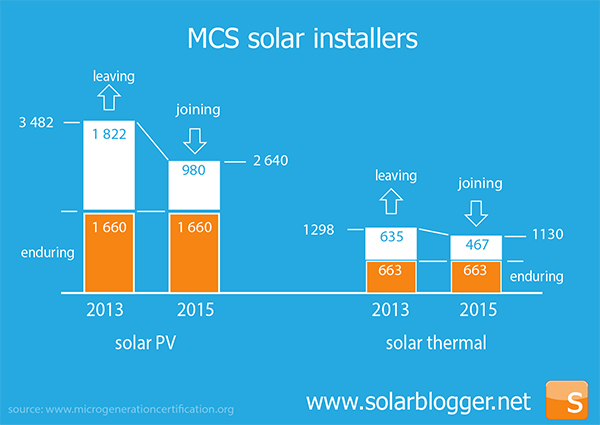
I recently had the opportunity to have a look in more detail at the list of installers registered with MCS, and what I found came as quite a surprise to me.

The number of solar PV installers registered with the Microgeneration Certification Scheme (MCS) has been on a declining path since the boom of 2010-11.  This is not news to anyone in the industry.

Right now, the number of solar PV installers registered with MCS (removing duplicates) is around 2,640, a fall of 24% since 2013.  But when you look at the actual companies that make up this headline figure you find that less than 50% of the solar PV installation companies on the list in 2013 remain two years later. 1,822 companies have left the market, but 980 new companies have joined the list in the last two years.


Churn Rates in Solar Installation Businesses

Turning to the list of solar thermal companies, we see that the decline in numbers has not been as severe as for the PV installer companies, a 13% drop from 1,298 companies in 2013 to 1,130 now.  However, the churn rate is just as eye-watering.  Nearly half of the solar thermal installers registered with MCS in 2013 are no longer on the list, but the 635 that have left have been replaced by 467 new companies.

What's going on?  Are these attrition rates normal for similar industries (home improvements, heating, electrical works)?  Or is there something 'special' about our solar industry?

Clash of Clans Hack Tool Android Unlimited Resources

clash of clans hack tool unlimited gems

Good news for clash of clans players. We have made a clash of clans hacktool which can give you unlimited supply of resources.  You can getunlimited supply of elixir, gems and coins. This hack tool works on android IOS tablets IPads and many other devices. This works well even with non-rooted devices. Also jailbreak is not required in case of IOS devices. It’s been provided with hyper threaded resources decryption, soadding resources just takes a few seconds.
Clash of clans is a very nice game with awesome graphics. And since many people are playing this game these days, and many struggling to get gems and stuffs why don’t you try our hack cheat? As you know with unlimited gems coins and elixir supply you can play the game to the full extent. Clash of clan hack tool will be updated every day so that it works all the time. Look at the screenshot of our hack below. And read the instructions below before you run into any problem. We hope this clash of clan hack helped you. Don’t forget leave a good review below. Have a nice day guys!

clash of clans hack tool

Clash of Clans Hack Tool Features:

Ok-icon1 Generate unlimited gems.
Ok-icon1 Generate unlimited Coins.
Ok-icon1 Generate unlimited elixir.
Ok-icon1 Works with Android IOS Tablets and many other Mobil devices.
Ok-icon1 No root or jailbreak required.
Ok-icon1 Easy to use just plug and add.
Ok-icon1 Updates available every day.

Clash Of clans hack tool instructions:

1) Download the hack by clicking the download button below
2) Installed the necessary supporting software i.e. dotnet framework if you haven’t installed it.
3) Run the tool and plug your devices to your PC.
4) Click on connect. It should take about 20 seconds.
5) After your devices connects with your application, input your desired no of resources.
6) Click on the hack button.
7) After completion restart your game.
8) Done!

ScreenShot:

clash of clans screen

Did Clash of Clans hack  – Work?.

19,489 Votes for YES/45 For NO
 
Last Updated:  06-08-2015
download clash of clans cheat tool
****File is free from Virus*****
Note : Hack tool runs only in Windows PC !
Note : If you get any error while launching the app like “Not a valid win32 application” etc, download and install microsoft .net framework from here.

comments